Glass, silicone or plastic? It is a familiar starting point for comparing cupping cups, but material alone does not describe how a cup creates suction, how it fits a practitioner's workflow or what a buyer needs to verify before placing an order.
For distributors, importers and professional product buyers, a more useful comparison separates material from mechanism and then examines geometry, system configuration, documentation and maintenance requirements. This approach does not produce one universal winner. It produces a clearer specification.
Material and Suction Mechanism Are Separate Variables
Public guidance does not use one perfectly consistent taxonomy. The U.S. National Center for Complementary and Integrative Health describes cups made from glass, ceramic, bamboo or plastic, while separately describing different ways suction may be created. A South African Unani-Tibb professional guideline describes pistol-handle valve cups made from toughened glass or clear hard plastic. A practitioner education comparison presents a market shorthand: glass cups associated with fire-based methods, plastic cups with pumps and silicone cups with compression.
These descriptions overlap, but they are not interchangeable. A glass cup should not automatically be assumed to require fire, and a material label alone may not reveal whether the system uses a valve, pump, squeeze action or another method.
A product comparison can therefore begin with two separate questions:
What is the cup made from?
How is negative pressure created and adjusted?
Keeping those questions separate helps buyers avoid writing an incomplete specification based only on "glass," "silicone" or "plastic."
Translate Practitioner Workflow into Product Requirements
The intended workflow changes what matters in a cup system. Static placement, movement across the skin and work around contoured areas may involve different priorities. Those priorities can include cup shape, rim design, size range, visibility, grip, suction control and compatibility with the rest of the system.
Professional education pages and named-product manuals can be useful for identifying these workflow variables, but they should be read within their limits. A manufacturer manual explains its own system; it does not establish a rule for every product in the category. For example, the Meridius cupping-set manual documents cup shapes, components and operating steps for that named set. It is useful evidence about the questions a buyer may need to ask, not proof that every system is configured the same way.
Turn the workflow into specification questions:
- If the intended use involves static placement, gliding or contoured areas, which cup geometries and sizes support that workflow?
- If practitioners need to adjust suction during use, how does the mechanism allow that, and which components are required?
- If visual inspection matters, what can be verified about the actual cup rather than assumed from its material category?
- What training, care instructions and operating documentation accompany the named system?
This translation is commercially important. "Which material do you prefer?" is a broad preference question. "Which configuration supports the intended workflow?" is a specification question that a supplier can answer with product-level evidence.
Evaluate the Complete System, Not Just the Cup
Some cup systems depend on pumps, valves, connectors, tubing, extension pieces or replacement components. Others create negative pressure through the cup itself. These differences affect what arrives in the package, what users must learn and what may need to be replaced over time.
As a proposed evaluation framework, buyers can ask suppliers to identify:
- included cup quantities and sizes;
- the suction mechanism and every component it requires;
- optional versus standard accessories;
- replacement-part availability;
- packaging configuration and supplied instructions.
Without that detail, two offers that appear to describe the same product category may represent different systems.
Ask for Product-Specific Reprocessing Information
Cleaning, disinfection and reprocessing are high-risk topics. Requirements may vary by product, material, setting, jurisdiction and intended use. Buyers should not assume that advice for one named cup applies to another.
The Maryland Board of Acupuncture Clean Needle Technique Manual provides profession- and jurisdiction-specific guidance on cupping equipment and contamination controls. Its scope matters: it should not be treated as universal regulatory guidance. Product care instructions can also differ. For example, the Lure EDGE care page gives restrictions for its named silicone product, not for silicone cups as a whole.
For sourcing purposes, request the current manufacturer instructions for the exact product and verify them against the requirements of the target market and care setting. Appropriate questions include:
- Which cleaning or reprocessing methods are documented for this exact product?
- Are there method, temperature or chemical restrictions?
- Do separate components require different handling?
- Which instructions and supporting documents are supplied?
- Who must confirm suitability for the intended jurisdiction and professional setting?
This is a documentation check, not a substitute for local clinical, infection-control or regulatory review.
Move Beyond Durability Stereotypes
Simple category claims-such as one material always lasting longer or another always being easier to maintain-are difficult to use without comparable test methods. Across the source set reviewed for this article, durability and performance language was not supported by a shared testing framework that would justify a universal ranking.
Lifecycle factors may still affect total cost, but they should be investigated at product level. Buyers can ask about foreseeable failure points, replacement components, storage requirements, warranty terms and the evidence supporting any claimed service life. A material stereotype is not a substitute for those details.
An Eight-Part B2B Comparison Framework
The following checklist turns a broad material comparison into a procurement conversation.
1. Intended workflow
Define the professional setting and the workflows the system is expected to support. Avoid treating consumer convenience language as evidence of professional or distributor requirements.
2. Material
Record the verified material of the actual product. Do not infer its full behaviour from the category label alone.
3. Suction mechanism
Document how negative pressure is created, controlled and released, including any pump, valve or other required component.
4. Cup geometry and range
Compare available sizes, shapes, rims and contours with the intended workflow. Confirm what is supplied rather than relying on representative images.
5. System configuration
List every included and optional component, along with compatibility and replacement-part requirements.
6. Reprocessing documentation
Request product-specific instructions and identify who must verify them for the intended market, profession and care setting.
7. Lifecycle and maintenance
Examine storage, care restrictions, likely component replacement, warranty information and the evidence behind durability claims.
8. Supplier evidence
Ask the supplier to support specifications and claims with current product documents. Where information is missing, record it as an open verification item rather than filling the gap with category assumptions.
A RightBest Product Example
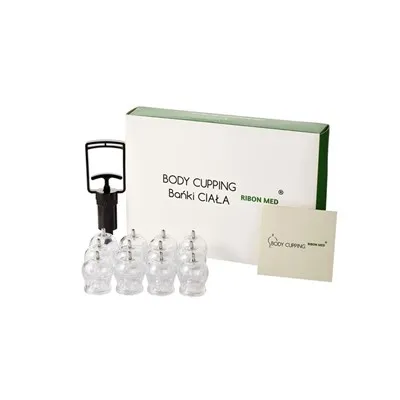
The RIBON MED® Body Cupping Glass Cup illustrates why material and mechanism should be recorded separately. Verified RightBest product information identifies it as a 12-cup set made from borosilicate glass. It creates manual negative pressure, and fire is not required to create suction.
Those facts describe the product at a high level. They do not establish its sizes, shapes, accessories, reprocessing method, certifications, clinical effects, durability or suitability for a particular market or care setting. Those points require separate verified documentation.
Conclusion
The reviewed evidence does not support selecting cupping cups by material alone or naming one material as universally preferable. Glass, silicone and plastic are useful comparison categories, but a B2B decision also depends on suction mechanism, geometry, workflow, system configuration, product-specific documentation and lifecycle questions.
For buyers and suppliers, the practical next step is to turn the intended workflow into a written specification and identify which claims still require evidence. Clarifying those requirements before comparing offers is a more evidence-aligned starting point than relying on material stereotypes.
If you are evaluating a professional cupping product range, request the currently verified specifications for the RIBON MED® Body Cupping Glass Cup and list any market-specific information that still needs confirmation.
Sources
Cupping - U.S. National Center for Complementary and Integrative Health
Unani-Tibb Guideline for Cupping Therapy - Government of South Africa
Cupping Therapy: Traditional and Modern Methods - MassageTherapyCEU
Meridius Cupping Set User Manual - Acuprime
Clean Needle Technique Manual, February 2024 revision - Maryland Board of Acupuncture