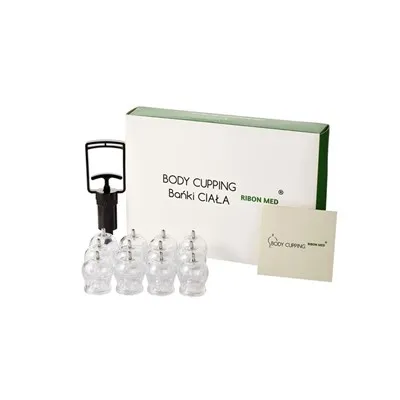
Desk neck rarely responds to more force. Firm pressure pushes tissue down, and the body often guards against it. A negative-pressure approach lifts the skin and superficial fascia upward first, then glides along the shoulder line. With a 12-cup borosilicate glass set, a session runs 5–15 minutes and the lift is visible through the transparent cup.
Why the downward approach plateaus
Anyone who works at a desk for long hours knows the feeling: shoulders creep up, the neck turns stiff, and pressing helps for a few minutes before the tightness returns. The reason is direction. Manual pressure is compressive. When pressure builds, tissue tends to protect itself, and the work stays near the surface.
Lift first, then glide
With a hand pump, each cup is drawn onto the skin - an upward lift you can see. Once the cup holds, it is moved slowly along the muscle line. Our training material shortens this to Lift ↑ and Glide →. The sequence is the point: space first, then movement.
Specs at a glance
| Item | Specification |
|---|---|
| Model | RBFFGC |
| Cups | 12 pcs, borosilicate glass, transparent |
| Cup diameter | Ø 3.5 cm |
| Pump | Manual hand vacuum pump (pistol type) |
| Session time | 5–15 minutes |
| Classification | CE MDR 2017/745 Class I; ISO 13485 |
| Testing | 100% negative-pressure test per cup at factory |
What the literature says
Clinical evidence on cupping is mixed and should be read carefully. A 2025 systematic review and meta-analysis in BMJ Open found immediate effects on pain intensity in chronic musculoskeletal pain, but no significant improvement in functional disability or mental health. A 2018 BMJ Open review on neck pain reported reduced pain versus inactive controls while noting low-to-very-low evidence quality. We cite these to keep the conversation honest, not to imply product-specific outcomes.
A note on claims
This is a non-invasive negative-pressure tool for everyday muscle relaxation and soft-tissue comfort. It is not intended to diagnose or treat disease. Product details: https://www.cuppinghealth.com
Frequently asked questions
- Why does my neck get tight at a desk? Prolonged static posture and sustained shoulder elevation are common contributors. Breaks and movement are worth building into the day.
- Is pressing the same as lifting? No. Pressing applies downward compression; negative pressure lifts the skin and superficial tissue upward before gliding.
- Can I use this on my own shoulders? The set includes a manual pump and a guide. Many users start with a light setting and a short hold.
- How long does a session take? 5–15 minutes, adjusted to the area and the individual.
- Will it leave marks on the neck? Suction and hold time are adjustable. Lighter settings and shorter holds are typically used on sensitive areas.
- What does creating space mean? It refers to the visible separation of skin and superficial tissue from deeper layers under suction - a mechanical description, not a clinical outcome.
- Is the glass safe? Cups are borosilicate glass and individually pressure-tested. Handle with care and use padded transport.
- What classification does the product hold? CE MDR 2017/745 Class I, manufactured under ISO 13485. Certificate scope is detailed on the product page.
Related reading: Calf cupping: what 12 glass cups actually do and Press down or lift up? Cupping direction explained.