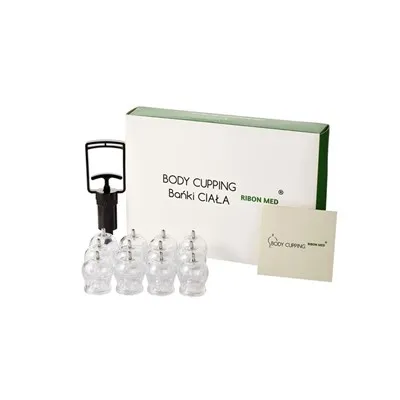
Cupping direction changes the technique. Compressive work presses down; a negative-pressure glass cup lifts the skin and superficial tissue upward before gliding along the muscle line. A 12-cup borosilicate set with a manual pump runs 5–15 minutes per session. The three steps are often noted as PRESS ↓, LIFT ↑ and GLIDE →.
PRESS ↓: what compression does
Manual techniques generally apply downward force. That has its place, but under sustained pressure the body often responds by guarding. For practitioners, the practical limit is how deep the work reaches when the client tenses against it.
LIFT ↑: creating space first
With a hand pump, the cup is drawn onto the skin. Through transparent borosilicate glass you can see the tissue rise into the cup. This is a mechanical description of what happens - separation of skin and superficial tissue from deeper layers under suction - not a clinical claim.
GLIDE →: movement under suction
Instead of leaving cups static, the cup is moved slowly along the muscle line while suction holds. Many practitioners describe this as the step that differentiates a myofascial approach from traditional static cupping.
The professional frame: MFD
Internationally, the combination of negative pressure, glide and movement is discussed as Myofascial Decompression (MFD). It gives distributors and clinics a vocabulary that sits alongside other manual-therapy approaches.
Specs at a glance
| Item | Specification |
|---|---|
| Model | RBFFGC |
| Cups | 12 pcs, borosilicate glass (transparent) |
| Cup diameter | Ø 3.5 cm |
| Cup weight | approx. 55 g (±5 g) |
| Pump | Manual hand vacuum pump (pistol type) |
| Session time | 5–15 minutes |
| Classification | CE MDR 2017/745 Class I; ISO 13485 |
| Testing | 100% negative-pressure test per cup at factory |
Evidence, stated plainly
We keep claims narrow on purpose. A 2025 systematic review in BMJ Open reported immediate effects on pain intensity in chronic musculoskeletal pain but no significant change in functional disability or mental health. A 2018 BMJ Open review on neck pain noted reduced pain versus inactive controls alongside low-to-very-low evidence quality. Neither is product-specific evidence.
A note on claims
This is a non-invasive negative-pressure tool for everyday muscle relaxation and soft-tissue comfort. It is not intended for diagnosis or treatment of disease. Product details: https://www.cuppinghealth.com
Frequently asked questions
- What does cupping direction mean? It describes the vector of the technique: downward compression (press), upward lift under suction, and lateral movement (glide).
- Is glide cupping the same as static cupping? No. Static cupping holds the cup in place; glide cupping moves it slowly along the muscle line while suction is held.
- What is Myofascial Decompression? MFD is a term used in professional settings for approaches combining negative pressure, glide and movement. It is a framework, not a product claim.
- Why does the cup need to be transparent? Transparency lets the practitioner see the lift and the tissue response, which helps with control and with explaining the technique.
- How long does a session last? 5–15 minutes, adjusted to the area and the individual.
- Can suction be adjusted? Yes. The manual pump controls the level, and hold time can be shortened on sensitive areas.
- What material are the cups? Borosilicate glass, individually pressure-tested at the factory. Glass requires careful handling and padded transport.
- Is the product certified? It is Class I under CE MDR 2017/745 and manufactured under ISO 13485. Certificate scope is on the product page.
Related reading: Calf cupping: what 12 glass cups actually do and Desk neck: why pressing harder won't release tight shoulders.