Fascia is central to understanding negative-pressure lift. When negative pressure is established inside a cup, the visible direction of movement is upward: the skin rises, the subcutaneous tissue changes shape with it, and the superficial fascial system sits within this connected superficial tissue environment.
This is the mechanical context behind a simple sequence:
FASCIA → LIFT ↑ → GLIDE →
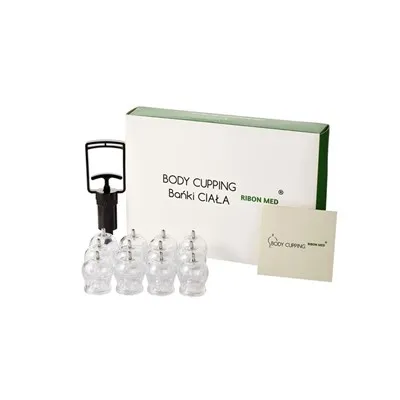
Lift begins as a local change inside the cup boundary. When stable suction is combined with controlled movement, that lifted interaction can travel across the body surface. The RIBON MED®Body Cupping Glass Cup makes this sequence visible through transparent glass: first the upward lift, then the transition into controlled glide across a body contour.
Understanding the sequence starts with one direct question: what is actually being lifted?
What Does "Fascial Lift" Mean?
"Fascial lift" connects the visible upward movement with the anatomy of the superficial tissue layers. A cup creates a local seal. As pressure inside the cup is reduced relative to the surrounding air, the surface rises into the chamber.

The movement can be understood through three connected elements:
Skin → Subcutaneous Tissue → Superficial Fascial System
Skin forms the visible outer surface. The subcutaneous tissue beneath it deforms as the surface rises. Within this subcutaneous context, fibrous connective structures form the superficial fascial system. These structures belong to one connected superficial tissue environment, so the lift is best understood as the elevation and deformation of that connected complex.
Research gives the visible interaction a measurable basis. A biomechanical model of cupping described how vacuum pressure changes tissue stress within the area enclosed by a cup. A dry-cupping study also recorded local soft-tissue elevation in its studied setup. Together, these findings support the mechanical picture seen through transparent glass: negative pressure changes the shape and height of the surface within the cup boundary.
Why Negative Pressure Creates Lift
Pressure direction makes the Lift concept easy to see.
PRESS ↓ - external pressure pushes inward.
LIFT ↑ - negative pressure draws the surface upward.

Press is useful here only as a contrast. The central idea is Lift: a visible upward change created by a pressure difference. The cup rim defines the local boundary, while the clear chamber provides space for the surface to rise. This lets the viewer follow the relationship between the seal, the elevated contour and the tissue immediately around it.
The transparency of the RIBON MED®Body Cupping Glass Cup gives this upward direction a clear visual frame. Lift becomes observable rather than abstract: the surface rises within a defined area, and the relationship between cup position and tissue shape can be seen as it happens.
Where Does Fascia Fit Into the Lift?
Superficial fascia is easiest to understand in relation to the tissues around it. Skin sits at the surface. Beneath it lies subcutaneous tissue. Within that superficial layer, the superficial fascial system forms a fibrous connective network.

An anatomical study of the back describes this system as a connective network bridging different levels of dorsal subcutaneous tissue. That makes the sequence skin → subcutaneous tissue → superficial fascial system a useful anatomical map for the visible lift.
This connected-layer view explains why fascia belongs in the story. The shape beneath the cup is not produced by skin alone. Suction research describes stretching of the skin and underlying tissue, while the cupping research above records local elevation of soft tissue. The superficial fascial system is anatomically relevant because it exists within this connected superficial tissue context as the surface rises and changes shape.
The result is a clear public explanation: fascia provides the anatomical context for the lift, while negative pressure provides the upward mechanical direction.
From Lift to Controlled Glide
Lift is the starting point. Controlled Glide adds movement.
When a cup remains in one position, the upward draw stays localized within its boundary. When stable suction is maintained and the cup begins to move, the lifted interaction changes position across the surface:
establish stable suction → observe Lift ↑ → guide controlled Glide →
This is where the product story becomes dynamic. The RIBON MED®Body Cupping Glass Cup allows the operator to see the local rise through the chamber while guiding the cup along a selected path. The hand stabilizes the cup, the seal supports the lift, and the movement path follows the body contour.
"Controlled" matters because body surfaces are not uniform. A broad area can support a longer, more open path. A rounded or narrower area calls for more compact movement and closer attention to cup positioning. Operator handling connects these elements: stable contact, deliberate direction and a path suited to the contour being shown.
Lift and Glide therefore describe two stages of one visible mechanical sequence. Lift identifies the upward direction created by negative pressure. Glide describes how the cup carries that lifted interaction across the surface.
Where Can Lift + Glide Be Demonstrated?
Real body areas make the mechanics easier to understand because each contour changes how the cup is positioned and guided.
Shoulder and upper back. The shoulder combines a rounded contour with the broader upper-back surface. Shorter controlled Glide paths can follow the local curve, while a slightly more open path can be shown across the upper back. Cup positioning and hand support remain visually important as the direction changes.
Back. The back provides a broader surface for demonstrating a clearly visible Lift and a longer Glide path. A side or three-quarter view can show the cup boundary, the elevated surface and the direction of movement together.
Thigh. The thigh presents a larger curved contour. The cup can be positioned so the operator's hand remains stable while guiding a wider Lift + Glide movement along the surface. The path follows the contour rather than treating the area as flat.
Calf. The calf is narrower and more rounded. This makes cup placement and glide direction especially visible. The movement path is naturally more compact, and the operator adjusts hand position as the cup follows the curve.
Across all four areas, the purpose of the demonstration is the same: show how stable Lift becomes controlled Glide as cup position, path length and handling adapt to the body contour. Product use should follow the applicable product information and instructions.
The Key Idea: Fascia, Lift, Glide
FASCIA - understand the connected superficial tissue context.
LIFT ↑ - negative pressure creates visible upward movement.
GLIDE → - controlled suction allows that lift to move across different body contours.
Together, these three ideas define the article's product story. The RIBON MED®Body Cupping Glass Cup provides a transparent view of negative-pressure lift and a practical way to demonstrate its transition into controlled movement across the shoulder and upper back, back, thigh and calf.
The central message is direct:
FASCIA + NEGATIVE-PRESSURE LIFT + CONTROLLED GLIDE